
A good fabrication reference needs to be useful when the drawing is open, the measurements are in hand, and the next step needs to be clear. That is the purpose behind Black Book — The Complete Fabrication Handbook by Næxon: bringing practical fabrication methods, worked calculations, technical drawings, and reference data together in a file you can keep on your phone.
We are introducing Black Book as an upcoming Næxon digital product. The current edition is in technical review, with sample pages available to explore. Purchasing will open after the remaining review and device testing are complete.
One reference, from layout to final inspection
Fabrication rarely stays inside one category. A piping spool can involve drawing interpretation, fitting dimensions, offset geometry, material identification, joint preparation, assembly, and inspection. Sheet, plate, and structural work bring their own layout and forming questions. Black Book brings these connected tasks into one reference rather than treating the calculation, the drawing, and the finished assembly as separate subjects.
The handbook covers 72 subjects across 12 parts. Its scope includes pipefitting and pipe fabrication, sheet metal, plate, structural fabrication, materials, calculations, drawings, assembly, inspection, and troubleshooting. It is intended for apprentices building a foundation and experienced tradespeople who want a practical place to check a method or find a reference.
That broad scope does not mean every table or example applies to every job. Reference notes identify the stated units, assumptions, ranges, and limitations. The actual work still follows the released drawing, project specifications, and applicable procedures.
Calculations that explain the inputs
A useful calculation begins before the formula. You need to know what each dimension represents, where the reference points are, which units you are using, and what allowances belong in the model. Black Book places definitions and assumptions beside the methods so a reader can understand the result instead of only copying a number.
The offsets chapter is one example. It separates true offset, advance, intersection travel, rise, roll, and pipe cut length. These quantities are related, but they serve different purposes. Fitting takeoffs and the stated joint-opening convention determine how the calculated travel becomes a connecting pipe length.
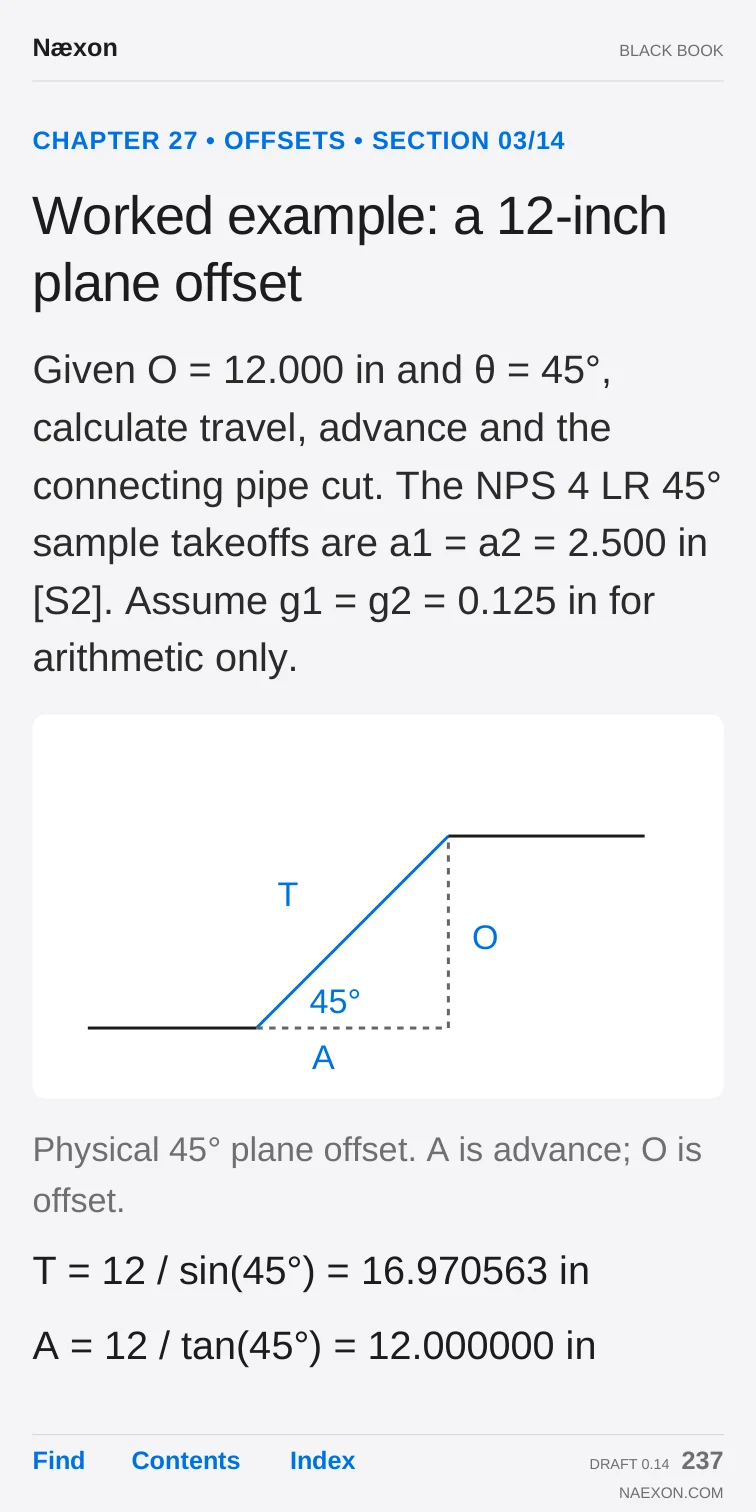
The worked examples show how the method develops from those inputs. Verification steps help the reader reconstruct the geometry or check the dimensional chain. Keeping the calculation and its check together makes it easier to catch a wrong reference, a missing allowance, or a unit mismatch before carrying the result into the next step.
For an interactive calculation alongside your reading, explore Numerus. Black Book provides the written explanation and reference context; the calculator provides another way to work through selected field calculations.
Clean diagrams and clearly labeled reference tables
The handbook uses a restrained visual style: light pages, dark text, thin technical linework, and blue accents where they help identify a dimension or a navigation link. Piping diagrams use traditional single centerlines. The aim is to make the geometry easier to follow on a small screen without adding visual clutter.
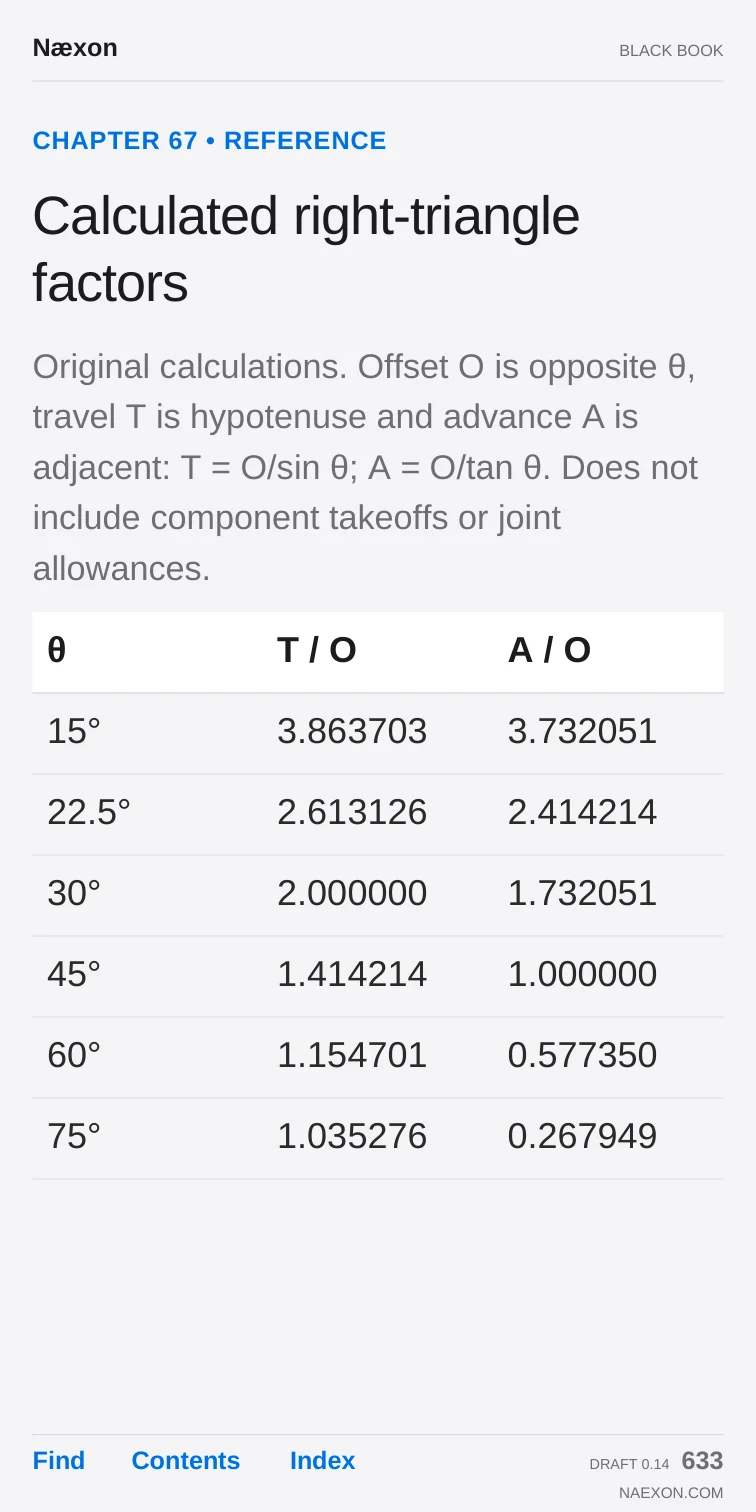
Reference tables are presented with their definitions and limits. For example, the right-triangle factor table identifies the relationship between angle, offset, travel, and advance. Its accompanying note makes clear that those geometry factors do not include fitting takeoffs or joint allowances.
Black Book also covers material and dimensional references, unit conversions, pattern development, forming calculations, and measurement checks. Readers working with component dimensions can also explore In-dex. For related layout work, Ayso supports piping isometric drawing, while Rapit focuses on saddle-pattern development.
A downloadable handbook you can keep on your phone
Black Book is being prepared as a searchable PDF. The file is designed to be saved on a phone, tablet, or computer and opened in a compatible PDF reader. Once downloaded and saved locally, it can be read offline.
The large-type edition uses narrow pages and 22-point main text. This gives the methods room to breathe and helps readers follow calculations on a phone. The same PDF format can be opened on iPhone, Android, Windows, and Mac; readers can choose the PDF app that works best for their device.
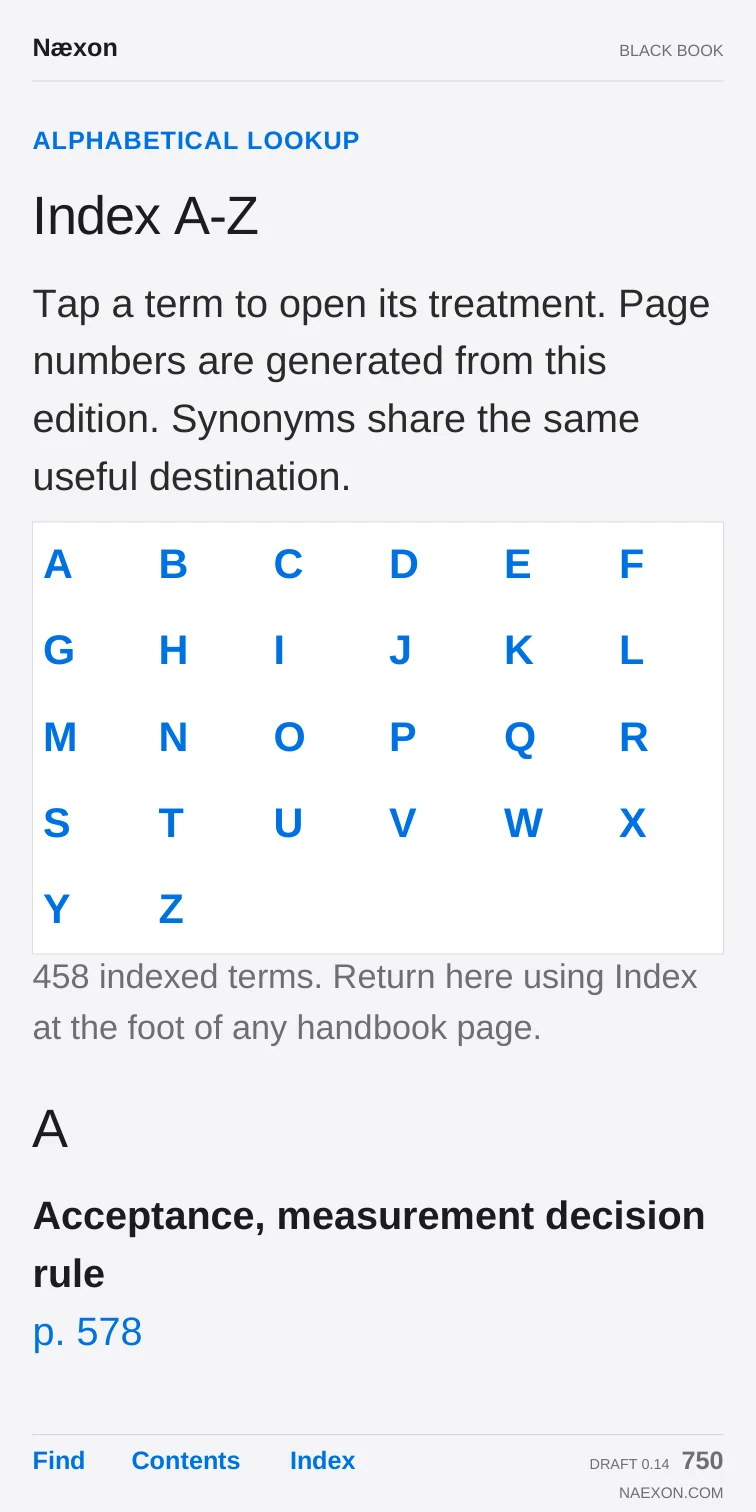
Search belongs to the PDF reader. Open the file, select the reader’s Search tool, and enter a word or phrase. The handbook also includes clickable contents, bookmarks, and a linked alphabetical index, giving readers several routes to the information they need.
Part of the Næxon learning toolkit
Black Book extends the same practical focus as the Næxon Learning Center. Articles explain individual subjects, courses build knowledge in sequence, and the handbook brings connected fabrication methods into a portable reference.
If you want structured lessons before moving into the handbook, explore the free Næxon courses. The course library includes industrial pipefitting, crane hand signals, and refinery units, with free access through an email subscription.
Explore Black Book before the release
The product page is the place to see the cover, review the subjects, and examine the current sample pages. Black Book is still in technical review. Independent specialist review and actual-device and print testing remain part of the work before paid release.
Pricing and checkout have not been finalized, and the handbook is not currently available to purchase. Explore Black Book and its sample pages to see the reference we are developing and follow its progress toward release.