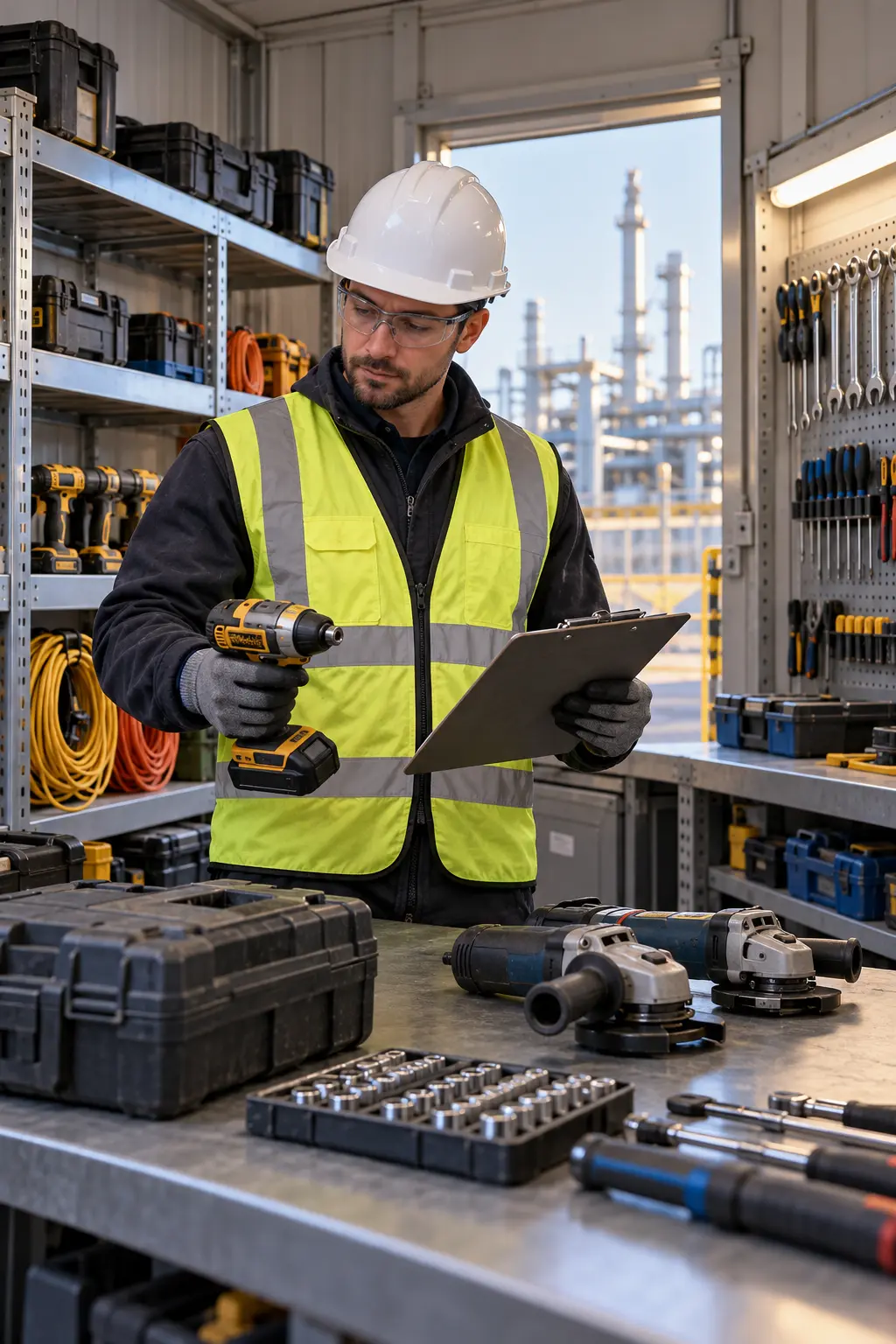
Picture the first worker at the tool-room window usually arrives with a simple request: one grinder, two batteries and whatever socket fits the thing nobody measured before walking over.
From the crew side of the counter, the exchange takes thirty seconds. Behind the counter, that thirty seconds may have started before daylight.
Cases were opened. Chargers were checked. Cords were sorted. A tool came back from yesterday with a new noise, and somebody had to decide that it still runs was not the same as it is ready to issue. The tool room is where a jobsite's shared equipment becomes an actual working system instead of a large pile with serial numbers.
The shift starts before the window opens
A good tool-room worker is reading the day before most crews have heard the assignment. Which craft is moving where? Is bolt-up starting? Are more grinders going out? Did the night shift return the specialty kit? Is the battery shelf full, or is everyone about to discover that twelve chargers and one outlet do not make a plan?
The answers change what gets staged. Common equipment moves toward the counter. Specialty tools stay controlled until the right request arrives. Consumables get counted before the last box becomes an archaeological discovery.
This is the larger version of building a gang box around the work. The difference is scale. Instead of organizing one crew's daily needs, the tool room may be supporting several crafts, shifts and supervisors at once.
A request is never just “a grinder”
Which grinder? What wheel or accessory does the task call for? Corded or battery? Does the crew need a guard, wrench, handle, charged battery or approved extension cord with it? Does the person receiving it have the information and authorization the site requires?
The attendant is not there to invent the work plan. The crew and supervision own the assignment. But a sharp tool-room worker notices when a request is incomplete and asks the question that saves a return trip.
That matters because industrial work uses far more than a few adjustable wrenches. The toolkits change from craft to craft, and even the same craft can need a different setup for layout, bolt-up, equipment setting or repair. The person behind the counter learns the rhythm without pretending every job is the same.
The counter is also a quality checkpoint
Construction rules require hand and power tools, whether furnished by the employer or the worker, to be maintained in a safe condition. That broad requirement is one reason a damaged cord, missing guard or questionable switch cannot be treated like a minor paperwork problem.
The exact inspection, tagging, testing and repair process belongs to the employer and the site's procedures. The tool-room worker follows that system. A tool that fails the check does not go back on the shelf because the morning line is getting long.
There is quiet judgment in that moment. Sending out the wrong tool quickly is not better service than sending out the right tool a minute later. And if specialized equipment has separate training, testing or issue controls, the checkout process has to respect them rather than becoming a shortcut around them.
Returns tell the story of the shift
At the end of the day, the counter sees the job come home one case at a time.
A clean specialty tool returns with every part. A socket set returns with one empty spot glowing like a warning light. A cord arrives in a knot that appears to have been tied during a weather event. Somebody brings back a drill and says, “It was doing that when I got it,” using the traditional tone of a person who would prefer no follow-up questions.
Good returns are more than neatness. Missing parts can be identified. Damage can be separated from service. Batteries can go back on charge. Consumables can be replenished. The next shift gets a fair chance instead of inheriting a shelf full of surprises.
Experienced workers already understand why the right tools should be available without carrying everything. The tool room makes that idea possible at project scale: the crew carries the assignment while the larger capability stays organized nearby.
The best tool-room workers know people, too
Equipment is only half the traffic. The other half is human.
One worker knows the item number. Another describes the tool by color, size and a hand motion. A new helper has been sent for something real but has not yet learned the name. An experienced hand knows exactly what is needed and exactly how quickly everyone else should move.
The person behind the counter translates without making a show of it. They ask useful questions, help the new hand learn the proper name and keep the line moving. They also learn which crew returns complete kits, which supervisor plans ahead and which missing adapter is about to become the most important object on the entire project.
That memory is not a substitute for inventory records or site controls. It is the practical layer that helps the system work when the morning gets loud.
Respect the system that keeps the tools ready
Bring equipment back through the required process. Report damage instead of hiding it in the case. Return the charger, wrench, handle and adapter that traveled with the tool. Do not raid another crew's staged equipment because their cart looks unattended.
And when the counter asks for an equipment number, signature or clarification, remember what the process is protecting. Shared tools have to remain findable, serviceable and available to the next person whose work depends on them.
When the tool room is running well, nobody calls it the reason the shift succeeded. The crew simply gets what it needs, the equipment works and the job keeps moving.
That is the strange reward of good support work: when it is done right, it looks like nothing happened.
But before the first grinder reaches the field, the tool room has already been working.