Morning Edition · Machinists · Apprentice · Math · 8-minute read
What you will learn: Identify pitch on a thread, distinguish threads per inch from millimeters per thread, convert between the two descriptions, check the answer, and recognize when a close number is still the wrong thread.
A bolt looks close to the tapped hole. A pitch-gauge leaf seems to sit on the crests. The first turn goes in by hand, then the fit tightens. That is the moment to stop—not to reach for a longer wrench.
Inch and metric threads can have similar diameters and similar spacing while still being different thread systems. A correct conversion helps a machinist compare spacing, but it does not change the thread form, tolerance class, diameter, flank angle, or approved drawing callout. This lesson teaches the spacing math. The print, thread standard, inspection plan, tooling data, and qualified supervision control actual production and acceptance.
If precision tools are new to you, review the fundamentals of calipers, micrometers, and dial indicators. Thread identification starts with clean observation and the right comparison tool, not with forcing two parts together.
Pitch describes one repeated spacing
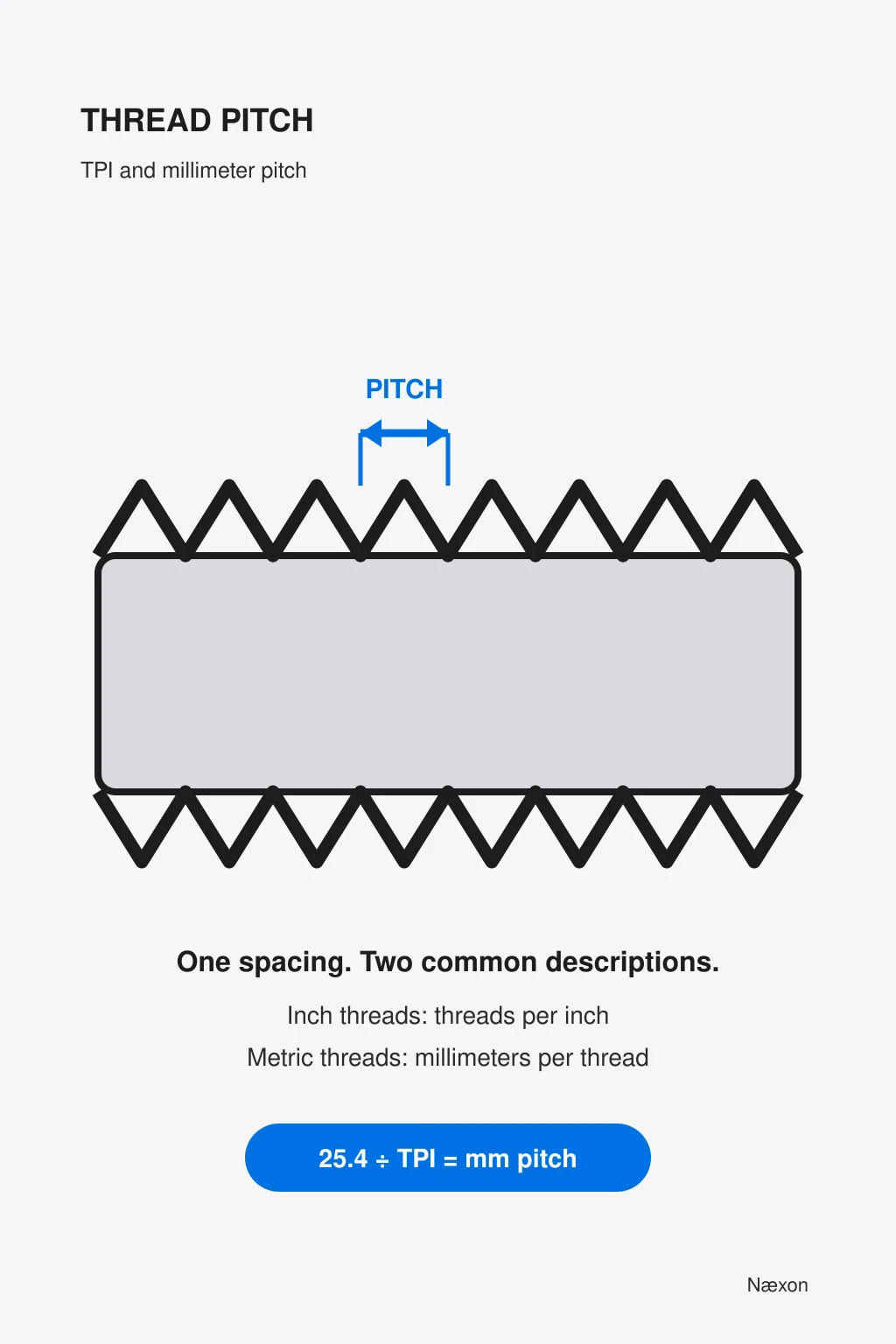
Thread pitch is the axial distance from a point on one thread to the corresponding point on the next thread. In plain language, measure crest to corresponding crest parallel to the thread axis. Measuring diagonally along a flank gives a different distance and does not represent pitch.
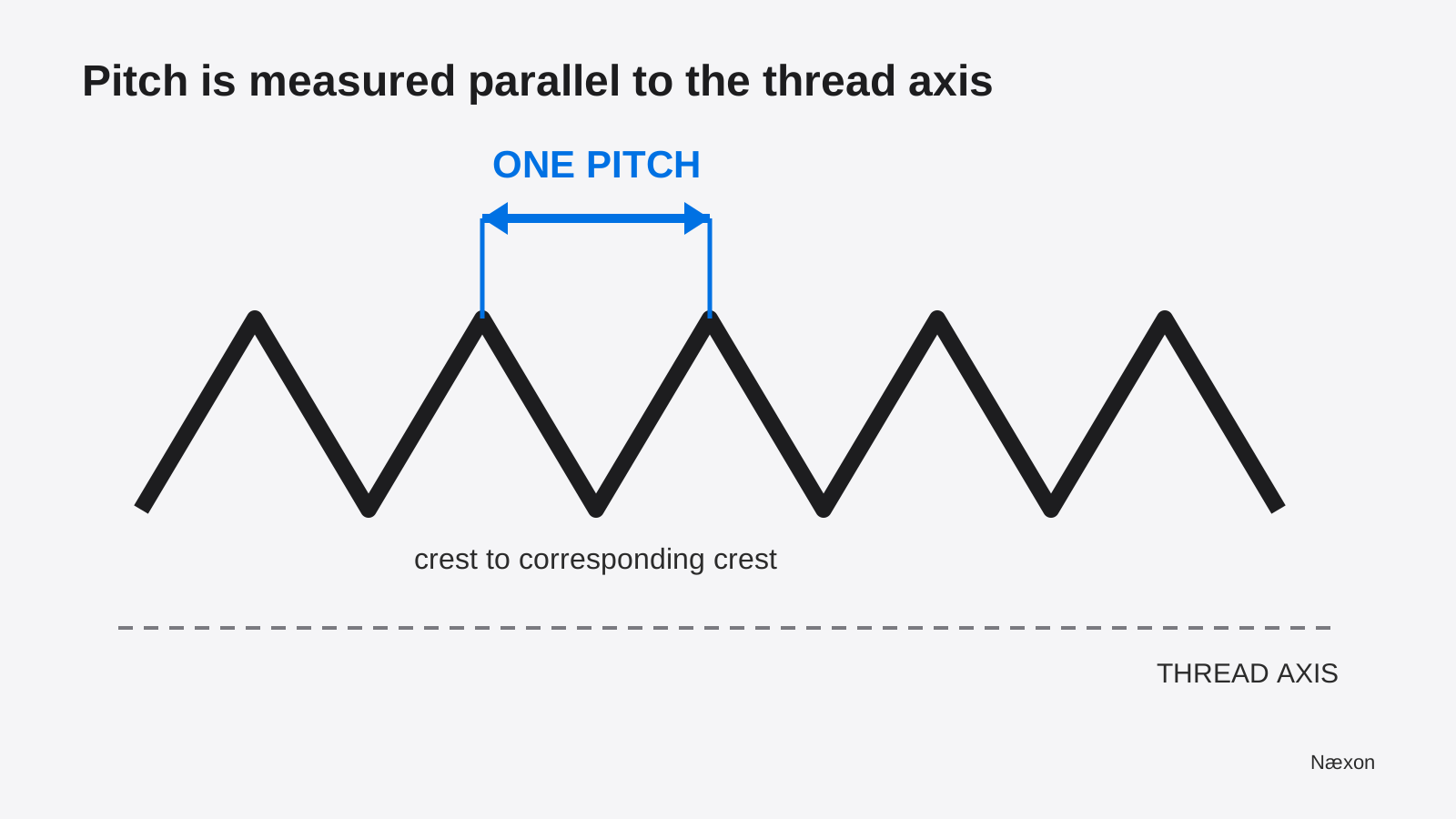
Metric thread callouts normally state pitch directly in millimeters. In the simplified designation M10 × 1.5, the nominal major diameter is 10 millimeters and the pitch is 1.5 millimeters. That means the thread advances one pitch spacing every 1.5 millimeters along the axis.
Unified inch thread callouts commonly state threads per inch, abbreviated TPI. In 3/8-16, the nominal major diameter is 3/8 inch and there are 16 thread pitches in one inch. TPI is a count per unit length, so a larger TPI number means a smaller spacing. That inverse relationship is the reason the conversion uses division.
The two conversion formulas
For an inch thread, the pitch in inches is:
Pitch (in/thread) = 1 in ÷ TPI.
Because one inch is exactly 25.4 millimeters, the same spacing in millimeters is:
Pitch (mm/thread) = 25.4 mm/in ÷ TPI (threads/in).
The unit check explains the formula. Millimeters per inch divided by threads per inch leaves millimeters per thread. To move the other direction:
TPI (threads/in) = 25.4 mm/in ÷ pitch (mm/thread).
These formulas compare spacing only. The converted result may not be a preferred or standard thread pitch, and it never proves that two parts are interchangeable.
Worked example: convert a 16-TPI thread
Assume the only task is to express the spacing of a single-start 16-TPI thread in inches and millimeters. No diameter, thread class, or acceptance decision is being inferred.
Define N = 16 threads/in. First calculate the inch pitch:
Pin = 1 in ÷ 16 threads = 0.0625 in/thread.
Now convert that distance to millimeters:
Pmm = 0.0625 in/thread × 25.4 mm/in = 1.5875 mm/thread.
The inches cancel, leaving millimeters per thread. No rounding was needed in the arithmetic, but a field note could reasonably state approximately 1.588 millimeters when the purpose is comparison. Do not round that result to 1.5 millimeters and call the threads equal. The drawing callout remains 16 TPI.
Check the result by reversing the calculation:
25.4 mm/in ÷ 1.5875 mm/thread = 16 threads/in.
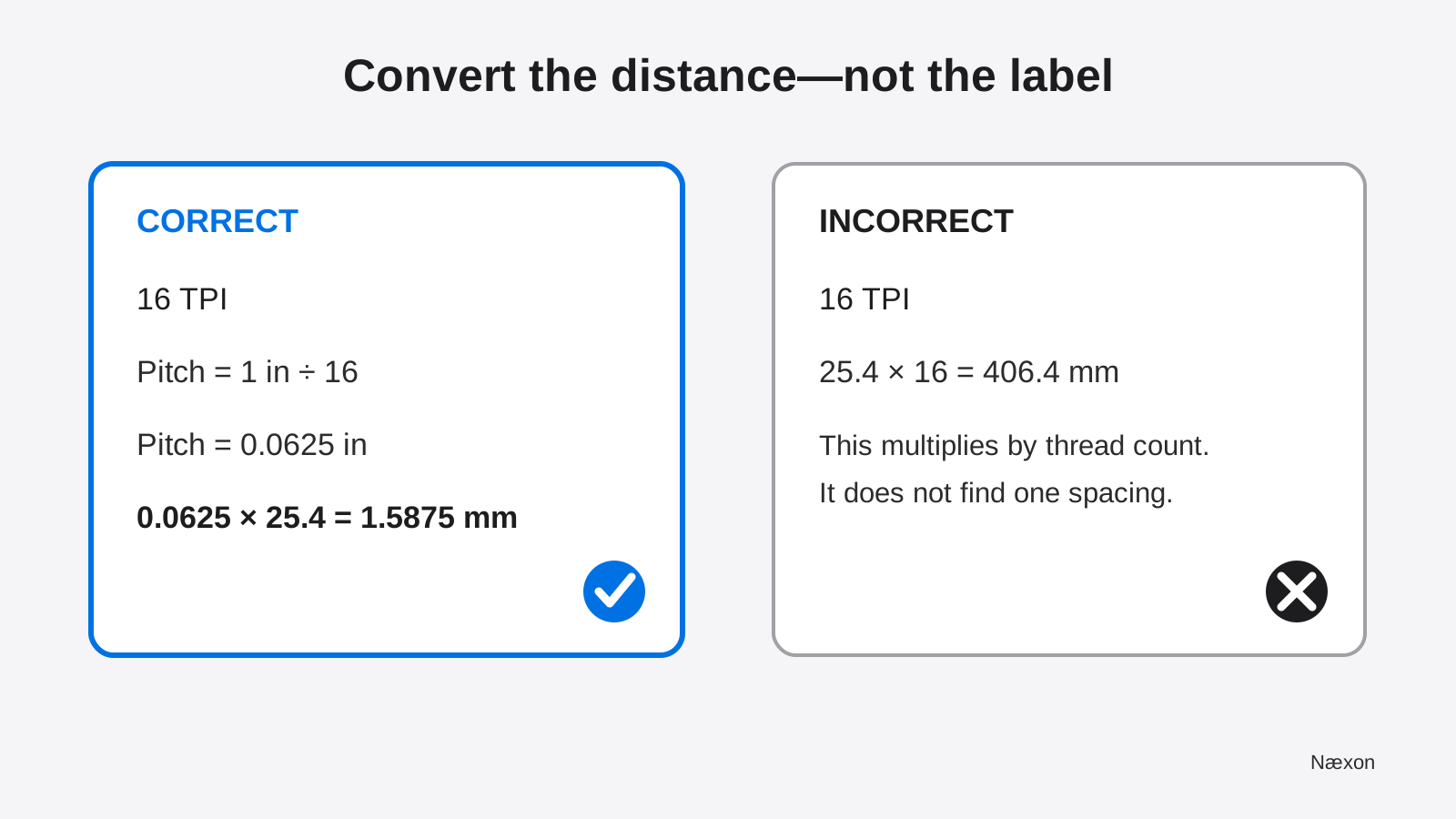
The answer is reasonable because 16 equal spaces must fit within one inch, and 1.5875 millimeters is a little more than one-sixteenth of 25.4 millimeters. Figure 2 shows the correct division and a common multiplication error.
Worked comparison: 1.5 millimeters is not 16 TPI
Suppose a metric drawing calls for a 1.5-millimeter pitch. Its TPI equivalent for spacing comparison is:
N = 25.4 mm/in ÷ 1.5 mm/thread = 16.933 threads/in.
Rounded for conversation, that is about 16.9 TPI. It is not a 17-TPI designation, and it is not 16 TPI. A 16-TPI thread has a 1.5875-millimeter pitch, so each spacing differs from 1.5 millimeters by 0.0875 millimeter.
That difference accumulates along engagement. Over ten pitches, the 1.5-millimeter thread spans 15.000 millimeters. Ten pitches at 16 TPI span 10 ÷ 16 = 0.625 inch, or 0.625 × 25.4 = 15.875 millimeters. The accumulated spacing difference is 0.875 millimeter. This is why mismatched parts may begin to engage and then bind.
A close decimal is a comparison clue, not permission to substitute. Confirm the complete designation on the drawing, part, gauge, or controlled reference.
Pitch and lead are equal only for a single-start thread
Pitch is the spacing between adjacent thread forms. Lead is the axial distance a mating part advances in one full revolution. For a single-start thread, lead equals pitch. For a multi-start thread, several thread helices begin around the circumference, so:
Lead = pitch × number of starts.
A two-start thread with a 2-millimeter pitch advances 4 millimeters per revolution. Calling that a 4-millimeter pitch would misdescribe the geometry. Multi-start identification requires the drawing or a deliberate start count; do not infer it from advance alone.
A practical identification sequence
- Read the callout first. Confirm the controlled print, model, work instruction, or manufacturer designation. Record whether it uses TPI or millimeter pitch.
- Clean without damaging. Remove chips, burrs, coating buildup, or debris by the approved method. Damaged crests can make a correct gauge rock.
- Check nominal diameter separately. Diameter and pitch answer different questions. A matching pitch does not prove a matching diameter.
- Use the correct pitch gauge set. Seat the leaf gently against several threads with light behind the contact. The correct leaf should match the spacing without rocking across the crests.
- Convert only when comparison helps. Carry units through the calculation and keep enough digits to avoid turning a near match into a false match.
- Verify the whole thread system. Confirm form, flank angle, internal or external condition, class or tolerance, handedness, and number of starts as required by the controlling documents.
- Escalate uncertainty. Stop before cutting, chasing, tapping, or assembling when the callout and measured condition disagree.
The same discipline applies when setting a machine. The lesson on feed per revolution versus feed per minute shows why an operator must confirm what each displayed unit means before using a number.
Troubleshooting a pitch that will not verify
If the gauge contacts at one end but opens a visible gap at the other, recheck the selected leaf and the measurement direction. You may have chosen a near pitch, held the gauge at an angle, or contacted damaged crests. Compare several consecutive threads instead of judging one valley.
If a part starts by hand and then binds, stop. Likely causes include mismatched pitch, different thread form, taper versus straight thread, burrs, damage, contamination, coating thickness, incorrect diameter, or crossed engagement. The corrective principle is identification and inspection—not more torque.
If a machine cuts the correct-looking profile but the pitch is wrong, verify the programmed unit mode, feed-per-revolution command, spindle synchronization, gear or change-wheel setup where applicable, and the programmed TPI or metric pitch. Do not alter offsets randomly. Preserve the part and program evidence, then follow the shop’s troubleshooting and approval process.
If the calculated value seems unreasonable, use the inverse check. A result of 406.4 millimeters for 16 TPI fails immediately because one pitch cannot be sixteen inches long. Units and a physical reasonableness check catch that error before it reaches the machine.
Common mistakes and Field Rules
The most common calculation mistake is multiplying when the question asks for one spacing. Another is dropping units and treating 1.5, 16, and 0.0625 as interchangeable labels. A third is rounding a converted comparison to the nearest familiar designation and silently changing the specified thread.
Machinists also confuse pitch with lead on multi-start threads, use diameter as proof of pitch, or force a nearly matching fastener. None of those methods verifies a thread.
- Pitch is a distance parallel to the axis; TPI is a count per inch.
- Use 25.4 ÷ TPI for millimeter pitch and 25.4 ÷ millimeter pitch for TPI.
- Keep the original drawing designation after conversion.
- A close spacing does not prove matching form, diameter, class, or fit.
- For multi-start threads, lead equals pitch multiplied by the number of starts.
- Never use assembly force as a thread-identification tool.
Knowledge Check
- A drawing calls for 20 TPI. What are the pitch in inches and the equivalent spacing in millimeters?
- A gauge leaf marked 1.25 millimeters fits a thread. What TPI spacing does that approximate, and why is that answer not a complete identification?
- A two-start thread has a pitch of 3 millimeters. What is its lead?
- A fastener begins to engage but tightens after two turns. What is the correct next action?
Answers and explanations
1. 1 ÷ 20 = 0.050 inch per thread, and 25.4 ÷ 20 = 1.27 millimeters per thread. The reverse check is 25.4 ÷ 1.27 = 20 TPI. 2. 25.4 ÷ 1.25 = 20.32 TPI. That spacing comparison does not establish the nominal diameter, form, tolerance class, handedness, or complete designation. 3. Lead = 3 millimeters × 2 starts = 6 millimeters per revolution. 4. Stop, separate the parts without adding force, and verify both complete thread designations and conditions under the approved process.
Practical Exercise
On paper, make a three-column table labeled Original Callout, Calculated Spacing, and Reverse Check. Calculate millimeter pitch for 8 TPI, 12 TPI, and 24 TPI. Carry four decimal places before rounding. Then calculate the TPI equivalents of 1.0-millimeter and 2.0-millimeter pitches.
Expected results: 8 TPI = 3.1750 mm, 12 TPI = 2.1167 mm, and 24 TPI = 1.0583 mm. The metric comparisons are 1.0 mm = 25.4 TPI and 2.0 mm = 12.7 TPI. A correct reverse check returns the original value within the rounding used. Circle the non-integer TPI results as reminders that a mathematical equivalent is not automatically a standard or interchangeable thread.
For the next step, connect pitch to machine motion with surface speed and spindle RPM. Together with feed-per-revolution knowledge, those fundamentals help separate rotation, axial advance, and cutting speed instead of treating every machine number as the same kind of quantity.